SpaceX's Starlink Launch: A Minor Delay, a Bigger FAA Headache
The Weather Delay and the Numbers that Matter
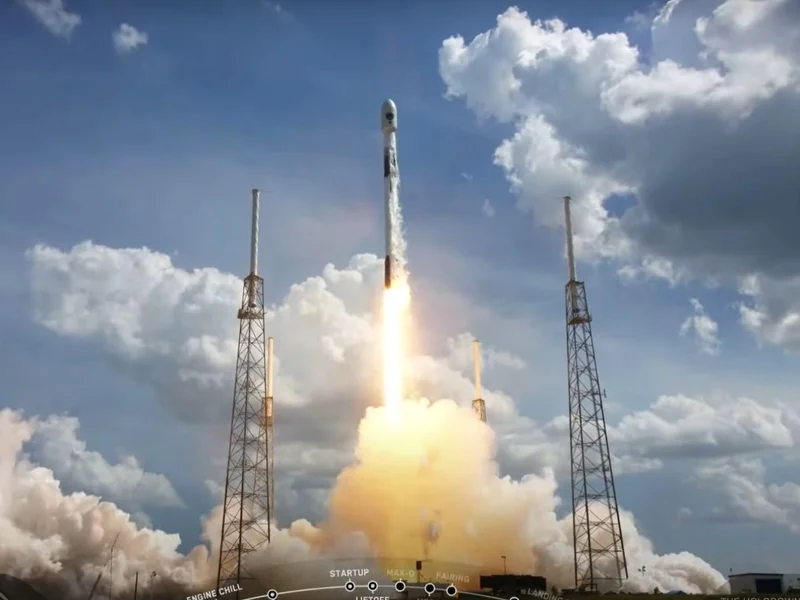
SpaceX managed to launch its Starlink 10-51 mission early Sunday morning after scrubbing the Saturday attempt due to bad weather in the booster recovery zone. The Falcon 9 lifted off from Kennedy Space Center at 3:10 a.m. EST, carrying 29 Starlink V2 Mini Optimized satellites. The 45th Weather Squadron had forecast a 95% chance of favorable weather, so the initial scrub raises an eyebrow. (Was the model that far off, or was there another factor at play?)
The B1069 booster, making its 28th flight, successfully landed on the drone ship ‘A Shortfall of Gravitas.’ Twenty-eight flights. That's a lot of wear and tear. It highlights SpaceX's booster reusability program, which they claim significantly reduces launch costs. But how much does refurbishment actually cost per flight after, say, flight number 20? Those numbers are conspicuously absent from the marketing materials.
The FAA's New Launch Curfew
Here's where things get interesting, and frankly, messier. Just days before the launch, the FAA issued an emergency directive restricting commercial space launches between 10 p.m. and 6 a.m. local time, starting November 10th. This is coupled with a "temporary 10 percent reduction in flights at 40 high traffic airports" due to the ongoing government shutdown, according to U.S. Transportation Secretary Sean Duffy.
This curfew is a major wrench in the gears. SpaceX has five more Starlink missions planned between Nov. 10 and Nov. 19, plus the Transporter-15 mission on Nov. 11. While they might be able to shuffle Starlink launch times, missions like Transporter-15, targeting Sun-synchronous orbits, could require special exemptions.
The FAA's reasoning isn't explicitly stated in the reports. Is it related to staffing shortages due to the shutdown, or something else entirely? Spaceflight Now reached out to the FAA for comment but received the automated "lapse in funding" response. Color me skeptical. Transparency is clearly not a priority here.
Rocket Lab, for its part, claims minimal impact, stating that launches from New Zealand are unaffected and expecting little disruption to launches from Virginia.
And this is the part of the report that I find genuinely puzzling. If the FAA's concerns are purely related to US airspace management, why would launches from a Virginia launch complex be minimally impacted? Either the FAA has a very specific (and unstated) concern, or Rocket Lab is downplaying a potential problem.
Fireballs, Starships, and Florida Skies
Adding to the chaos, ahead of the Sunday launch, Floridians reported seeing a "fireball" in the sky. Initially, some speculated it was a SpaceX rocket explosion, but that was quickly debunked. Turns out, it was likely a satellite reentry, possibly a Chinese upper stage rocket, according to some online chatter. Fireball spotted in Florida. Other times mystery streaks, rockets from out of state were seen
Social media is a fascinating, if unreliable, source of data. One user on X (formerly Twitter), @jconcilus, identified as a marine traffic operator and NASA Spaceflight (NSF) camera custodian, suggested the Chinese rocket theory. It's anecdotal, sure, but when you see enough of these independent observations converging, it's worth noting.
It wasn't the first time mysterious streaks have been visible in the Florida sky. Back in October, the SpaceX Starship launch from Texas was seen in Florida, some 1,500 miles away (that’s not a typo—one thousand five hundred miles). Residents as far as Boynton Beach reported seeing it, initially mistaking it for a meteor.
The frequency of these sightings raises a question: are we simply more aware of these events due to social media, or is there a genuine increase in space debris and re-entries? And what's the correlation between increased launch activity and the likelihood of these visible events?
The FAA's Playing Chicken with the Space Economy
The FAA's last-minute launch curfew is like throwing a wrench into a finely tuned engine. It smacks of regulatory overreach, especially given the lack of transparency surrounding the decision. While safety is paramount, these kinds of abrupt changes create uncertainty and stifle innovation. And at a time when the US is supposedly trying to maintain its lead in the space race, that's a dangerous game to play.